EPA Approves use of Potassium Chloride (liquid potash) in Christmas Lake -
The U.S. Environmental Protection Agency has approved the use of potassium chloride, or liquid potash, on Christmas Lake near Lake Minnetonka to kill off zebra mussels found near the boat launch this summer. The state Department of Natural Resources now plans to use it in the frozen lake this month once the state Agriculture Department approves potash as a registered use. The DNR put in the emergency exemption request for potash, which has been used successfully in two other states, Texas and Virginia. Last week, about two weeks later, the EPA gave its approval. Now, Minnesota could have the second lake in the country to use potash to kill off zebra mussels — and the first frozen one.
Keegan Lund, a DNR invasive species specialist, said it will be the first above-ice application of potash. Crews plan to drill a few holes in the ice and use hoses to treat the lake with the pesticide. The EPA’s approval includes both Christmas Lake and Lake Independence near Maple Plain. But because a barrier blocking off zebra mussels in Lake Independence was removed, Lund said potash may not be able to be used until next spring. If it works, like Zequanox, the pesticide isn’t likely to be a solution for every Minnesota lake and river. Officials say the treatments are too difficult and costly to kill off zebra mussels on larger lakes and ones that are fully infested.
Treatment for zebra mussels continues at Christmas Lake 11/5/14
A group of organizations has been acting swiftly to stop zebra mussels in Christmas Lake since they were discovered at the public boat launch in August -- and the battle continues.
In Sept., the Minnesota Department of Natural Resources (DNR) applied Zequanox®, a non-chemical treatment for zebra mussels, in a 3,000 square foot containment area around the public launch. After some zebra mussels were discovered just outside the containment area, the barrier was expanded to cover 3/4 of an acre.
As an additional component of the treatment, the DNR is currently treating the area with a new copper-based treatment called EarthTec QZ, as the water has become too cold for Zeqaunox to be fully effective. Copper is commonly used to kill algae, and EarthTec QZ is a new product aimed specifically at zebra and quagga mussels.
The MCWD's monitoring staff have not found any live mussels since the treatment. The organizations involved include the state Department of Natural Resources (DNR), state Department of Agriculture, MCWD, and City of Shorewood.
The DNR and Minnesota Department of Agriculture are also working with the federal Environmental Protection Agency to get permission to treat the area with potash (potassium chloride), which is also effective in killing zebra mussels.
As an additional measure, the DNR is planning to replace the boat launch at Christmas Lake next spring. The launch was already scheduled for replacement before zebra mussels were discovered.
If successful, Christmas Lake could become the first lake in Minnesota to eradicate zebra mussels, thanks to early detection and aggressive response. The District has collected extensive data on the response, including lab simulations of the various treatments. The response could serve as a model for response to other quickly-discovered infestations across the state and country.
|
Fall dock and equipment removal time is soon upon us! We want to remind folks to inspect all water-related equipment when it is removed from the water at the end of the season. Boat lifts and docks are of particular concern because they sit in the water for extended periods, giving adult zebra mussels a greater opportunity to attach themselves.
Immediately report any suspected zebra mussel discoveries to the local DNR area office. The primary contact for aquatic invasive species (AIS) issues in our region is Keegan Lund 651.259.5828
Lakeshore owners should also keep in mind that moving docks and boat lifts from one lake to another is a serious issue. State law requires that all boat lifts, docks and swim rafts removed from any lake, river or stream remain out of the water for 21 days before being placed into another water body.
|
 |
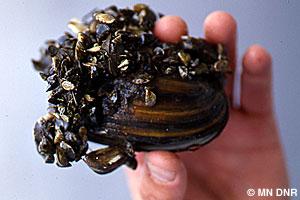
| Gabbriel Jabbour with zebra mussels |
|
|
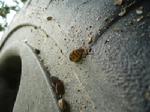 |
| ZM on plastic dock wheel |
|
|
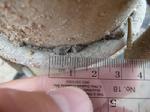 |
| ZM on lift next to hardware |
|
|
KARE Project H2O segment featuring Belinda Jensen diving in Lake Minnetonka to look for zebra mussels aired on November 1, 2012. Click the link below to view the video segment.
|
Your help is needed! We need to monitor our lake for zebra mussels. Become a Zebra Mussel Volunteer monitor!
How can you monitor for zebra mussels? In the late summer or fall when removing equipment from lakes or rivers:
1. Visually inspect hard surfaces for zebra mussels such as docks, dock floats and supports, swimming platforms, boats, motors, anchors, and any objects that have been in the lake or river for the summer. Check areas where zebra mussels may be attached, such as trim tabs, rubber gaskets, grooves along the keel of pontoon boats, and sailboat centerboards. During early infestations, zebra mussels are likely to be small (1/4-1/2 inch long) and the number attached on any object is likely to be low. You can also examine rocks and other hard surfaces along the shoreline and in shallow water, especially near water accesses.
2. Complete and send in an online volunteer monitoring form by November 1st each year. Send in the report whether or not you found zebra mussels.
3. Make your own monitoring device. Hang a PVC pipe , brick or cinder block under a shady spot of your dock (zebra mussels tend to avoid direct sunlight) in the summer to monitor for zebra mussels. Suspend the object as deep as possible at the end of your dock, keeping it at least one foot above the bottom. Examine the monitoring object, and add these observations to the Volunteer Monitor Report Form.
|
General Characteristics
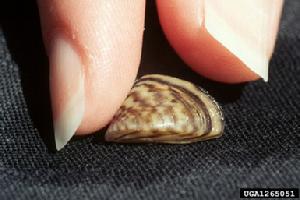
- Zebra mussels look like small clams with a yellowish or brownish “D”-shaped shell, usually with dark and light-colored stripes (hence the name “zebra”)
- They can be up to two inches long, but most are under one inch. Zebra mussels usually grow in clusters containing numerous individuals and are generally found in shallow (6-30 feet), algae-rich water
- Zebra mussels are the only freshwater mollusc that can firmly attach itself to solid objects – submerged rocks, dock pilings, boat hulls, water intake pipes, etc.
- On smooth surfaces, young zebra mussels feel like fine sandpaper.
- Juveniles are about the size of peppercorns.
Impacts: Zebra mussels can cause problems for lakeshore residents and recreationists. Mussels may attach to motors and possibly clog cooling water areas. Shells can cause cuts and scrapes if they grow large enough on rocks, swim rafts and ladders. Anglers may lose tackle as the shells can cut fishing line. Homeowners that take lake water to water lawns can have their intakes clogged. Zebra mussels can also attach to native mussels, killing them. Zebra mussels filter plankton from the surrounding water. If a lake has high numbers of mussels over large areas, this filter feeding could impact the food chain, reducing food for larval fish.
Status: They have spread throughout the Great Lakes and the Mississippi River from Brainerd downstream, and are now in other rivers and inland lakes. They are established in Minnesota and were first found in the Duluth/Superior Harbor in 1989. Some popular Minnesota lakes currently infested with zebra mussels include: Minnetonka, Pelican, Le Homme Dieu, Fish Lake, Prior lake, Gull lake and Mill Lacs. The Infested Waters list provides details of current infestations. Diving ducks, freshwater drum (sheepshead), and other fish eat zebra mussels, but will not significantly control them.
Means of spread: Mussels attach to boats, nets, docks, swim platforms, boat lifts, and can be moved on any of these objects. They also can attach to aquatic plants, making it critical to remove all aquatic vegetation before leaving a lake. Microscopic larvae may be carried in water contained in bait buckets, bilges or any other water moved from an infested lake or river.
What You Can Do
- Learn to recognize zebra mussels.
- Inspect and remove aquatic plants, animals, and mud from boat, motor, and trailer.
- Drain water from boat, motor, livewell, bilge, and bait containers.
- Dispose of unwanted live bait and worms in the trash.
- Rinse boat and equipment with high-pressure and/or hot water (140° F), especially if moored for over a day, OR
- Dry everything for at least 5 days. Non-native equipment (docks, lifts, swim platforms etc should be dried for 21 days or more when moved from lake to lake!)
- Never introduce fish, plants, crayfish, snails or clams from one body of water to another.
- Report new sightings - note exact location; place specimens in a sealed plastic bag or store in rubbing (isopropyl) alcohol; if in Minnesota, call the Minnesota Sea Grant Program in Duluth, (218) 726-8712; the Minnesota DNR in St. Paul, 1-888-MINNDNR, or (651) 259-5100; or a local DNR fishery office.
|
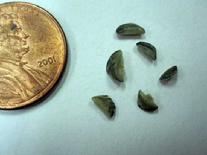 |
| Penny comparison |
|
|
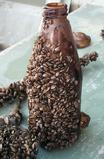 |
| attached to beer bottle |
|
|
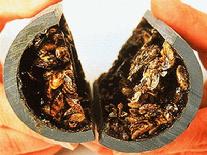 |
| inside irrigation pipe |
|
|
|