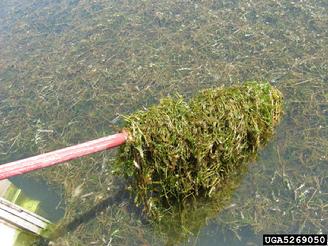
Invasive Aquatics: Eurasian Milfoil & Curly Leafed Pondweed
Lake Sarah contains a wide variety of aquatic plant life including two invasive exotics; Curly Leaf Pondweed and Eurasian Milfoil. The following plant descriptions intended are to help residents understand which aquatics may be specifically treated.
Curly-leaf pondweed (Potamogeton Crispus) is a perennial, rooted submersed vascular plant that was first noted in Minnesota about 1910 (Moyle and Hotchkiss 1945). Curly-leaf pondweed is known to occur in 740 Minnesota Lakes in 68 of the 87 counties. Unlike most native plants, curly-leaf pondweed plants remain alive through the winter slowly growing even under thick ice and snow cover (Wehrmeister and Stuckey 1978). Therefore, it is often the first plant to appear after ice-out.
By late spring, curly-leaf pondweed can form dense mats that may interfere with recreation and limit the growth of native aquatic plants (Catling and Dobson 1985). In mid-summer, curly-leaf plants usually die back, which results in rafts of dying plants piling up on shorelines, and is often followed by an increase in phosphorus (Bolduan et al 1994) and undesirable algae blooms. A key question underlying the management of curly-leaf pondweed is: to what extent do lakes experience algal blooms due to the presence of curly-leaf pondweed, and to what extent do lakes grow large amounts of curly-leaf pondweed due to the abundance of mid-summer algae and the nutrient regime that supports this condition? Curly-leaf plants usually die back in early summer in response to increasing water temperatures, but they first form vegetative propagules called turions (hardened stem tips). New plants sprout from turions in the fall (Catling and Dobson 1985). In order to obtain-long term control of curly-leaf pondweed, the production of turions must be stopped. It is not clear how many years of turion reduction it will take to produce long-term control of curly-leaf.
Eurasian watermilfoil (Myriophyllum spicatum) is an invasive submerged aquatic plant that was inadvertently introduced to Minnesota. Eurasian watermilfoil, hereinafter called milfoil, was first discovered on Lake Minnetonka during the fall of 1987. Milfoil can limit recreational activities on water bodies and alter aquatic ecosystems by displacing native plants. As a result, Minnesota established the Minnesota Department of Natural Resources (DNR) Invasive Species Program to manage milfoil and well as certain other invasive species. Milfoil is classified as a prohibited invasive species, which means that it may not be bought, sold, or possessed in Minnesota.MN DNR Eurasian Water Milfoil Fact Sheet in .pdf
Maps and charts showing the frequency and location of these plants from the most recent macrophyte study courtesy of the Three Rivers Parks Distict can be found on the TMDL Maps and Charts page.
Above descriptions excerpted from the published report Invasive Species of Aquatic Plants and Wild Animals in Minnesota – Annual Report for 2006 produced by the Minnesota Department of Natural Resources as submitted to Environment and Natural Resources Committees of the Minnesota House and Senate in 2007.
Understanding Eurasian Milfoil & Curly Leafed PondweedThe following links may be helpful in understanding more about the potential impact on the lake and suggest some possible methods for their control. Want to learn more about the studies, status, and programs currently in play in the effort to manage invasive species? The Invasive Species of Aquatic Plants and Wild Animals in Minnesota 2006 Annual Report published in January 2007 may be just what you are looking for! Each year, by January 15, the MN DNR is required to prepare a report for the legislature that summarizes the status of management efforts for invasive species (aquatic plants and wild animals) under its jurisdiction. This report must include expenditures, progress in, and the effectiveness of management activities conducted in the state, including educational efforts and watercraft inspections, information on the participation of others in control efforts, and an assessment of future management needs. Click on the blue title (link) above to view the 141 page report in Adobe Acrobat (.pdf) format.
Minnesota DNR guide to aquatic plants (including links to more information on each specific plant)
Invasive Species of Aquatic Plants and Wild Animals in Minnesota 2008 Annual Report published by the MN DNR in January 2009
Algae Blooms
Heat and Lack of Rain Can Bring Toxic Algae Blooms. As the thermometer climbs and a string of rainless days stretches on across parts of the state, some area lakes are starting to "green up." The Minnesota Pollution Control Agency (MPCA) reminds people that these conditions can produce toxic blue-green algae blooms in lakes and rivers that can harm pets, livestock and even people. “While not all algae blooms this time of year are harmful, the best policy is, when in doubt, stay out” said Steve Heiskary of the MPCA. Most algae blooms are harmless. Blue-green algae particularly thrive in warm, shallow, nutrient-rich lakes. Not every blue-green bloom is toxic, but it can be difficult to predict which ones will cause problems. Often the algae can be concentrated when the wind blows them to a windward shore. Most problems occur when the algae concentrate around a shoreline and animals drink the water or otherwise ingest the algae or humans get in the water. Distinguishing blue-green algae from other types may be difficult for non-experts. But toxic blooms generally look pretty nasty, sometimes said to look like pea soup, spilled green paint or floating mats of scum. They often smell bad as well. For more information about toxic algae blooms, go to http://www.pca.state.mn.us/water/clmp-toxicalgae.html
Floating cattail bogs
Who is responsible for removing a bog that floated across the lake and lodged on my shoreline? Is a DNR permit required to remove it?
When a floating bog has broken free from the shoreline by natural causes, and becomes grounded elsewhere on private or public property, the property owner(s) where the bog becomes grounded are responsible for removing the bog if they so desire. If there is no evidence to identify the responsible party or parties, the local government must assume responsibility. The DNR responsibility is limited to the following:
- Provide advice and approval on bog disposition.
- Obtain funds from the state agency involved when a floating bog has become lodged on the shoreline of state-owned lands.
- Remove any floating bogs lodged on state owned dams or other DNR property.
NOTE: Removing floating bog material requires a DNR aquatic plant management permit issued through the DNR Regional Fisheries Office where your shoreline property is located. Minnesota Rules 6280 describes permit requirements relating to the removal of aquatic vegetation.
Scott Walsh suggests (and the U of M agrees) that lakeshore owners should consider picking up weed debris from the lake that washes up along their shorelines. He has been doing it since he moved in and it has made a tremendous overall improvement to the lake bottom in front of his place. By removing dead and decaying material from your shoreline you can reduce the nutrients that foster weed and algae growth. Scott puts the weeds and leaves in his compost pile and in a year he has great soil that he can use around his house and garden.
|